









Paraboot has been making shoes in the French Alps since 1908 and still makes every pair in France, at a factory in Saint-Jean-de-Moirans run by the fourth generation of the founding family. The range here
Read More
24 products
Paraboot FAQs
A construction where the upper is turned outwards and stitched to the sole with two visible lines of stitching rather than one. It takes considerably longer to make than a standard welt, produces a joint that is close to watertight, and allows the shoe to be resoled repeatedly. It was developed for mountain boots, which is where Paraboot came from, and the brand is regarded as the world leader in it.
In France, at the company's own factory in Saint-Jean-de-Moirans in the south-east, close to where it started in 1908. Around 150 hand operations go into each pair, and the business is still owned and run by the fourth generation of the founding family.
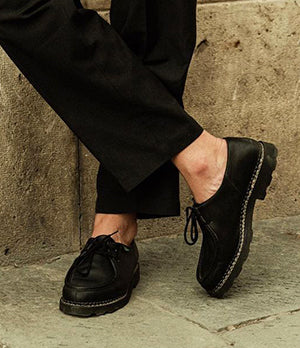
The Michael has a moccasin-style apron seam running over the toe, taken from Tyrolean walking shoes, which gives it the blunt rounded front it is known for. The Chambord is a plainer derby on similar construction without that seam. Both use the Norwegian welt; the Michael is the more distinctive and the Chambord the more understated.
Yes, and it is one of the main arguments for buying them. The welted construction means the sole can be replaced without disturbing the upper, so a pair kept in reasonable condition can be resoled several times over many years. Paraboot offers a resoling service, and good cobblers can also handle the work.