




Paraboot Mens Shoes & Boots

Filter

Paraboot has been making shoes in the French Alps since 1908 and still makes every pair in France, at a factory in Saint-Jean-de-Moirans run by the fourth generation of the founding family. The range here

Read More


22 products

About Paraboot shoes

Rémy-Alexis Richard was born into a farming family in Izeaux, a village at the foot of the Alps with about twenty small shoe workshops in it. He started as a cutter, worked out that the contractors in Paris were making more money than his employer, took his own designs to the city and sold them — then in 1908 began hiring staff of his own.

The name came later. On a trip to America in 1926 he saw people wearing rubber boots, brought the idea home, and started fitting leather uppers to cleated rubber soles. He registered Paraboot in 1927, after Pará, the Brazilian port the latex came through — and where the company still sources the rubber for its soles. The Michael arrived in 1945 and is the shoe that kept the business alive when other French makers were switching to glue and plastics.

Paraboot Michael, Chambord and Avignon shoes

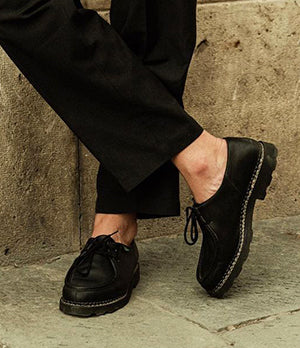
These are the derbies and they are what most people mean by a Paraboot. The Michael is the Tyrolean one — a blunt, rounded toe with a visible apron seam over the front, taken from Alpine walking shoes and improbably durable. The Chambord is the plainer relative, the same weight of construction without the moccasin front, and the Avignon is the sleekest of the three. The Micka and Malo sit alongside them in the same family of shapes.

What they share is the Norwegian welt. Paraboot is the world leader in it, and it is worth understanding: the upper is turned outwards and stitched to the sole with two visible lines of stitching rather than one. It takes far longer to make, it is close to watertight, and it can be resoled repeatedly. Around 150 hand operations go into a pair.

Paraboot boots, Thiers and the Pacific sandals

The Yosemite is the mountain boot in the range and the most obviously alpine thing here, in smooth leather and in toile. The Milly and Avoriaz are the other boots, the Avoriaz in nubuck. The Thiers is a different proposition — lower, wider, with a squared-off front, and it is the model that reads least like a dress shoe and most like something you would walk a long way in.

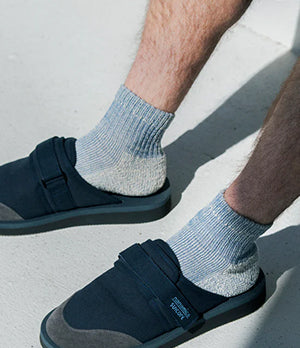
At the other end of the year, the Pacific is Paraboot's fisherman sandal, in the same leathers and on the same rubber soles as the shoes, which is why they last in a way most sandals do not.

Browse all footwear at Yards Store, or see what we have in our Manchester and Sheffield shops.

Paraboot FAQs

A construction where the upper is turned outwards and stitched to the sole with two visible lines of stitching rather than one. It takes considerably longer to make than a standard welt, produces a joint that is close to watertight, and allows the shoe to be resoled repeatedly. It was developed for mountain boots, which is where Paraboot came from, and the brand is regarded as the world leader in it.
In France, at the company's own factory in Saint-Jean-de-Moirans in the south-east, close to where it started in 1908. Around 150 hand operations go into each pair, and the business is still owned and run by the fourth generation of the founding family.
The Michael has a moccasin-style apron seam running over the toe, taken from Tyrolean walking shoes, which gives it the blunt rounded front it is known for. The Chambord is a plainer derby on similar construction without that seam. Both use the Norwegian welt; the Michael is the more distinctive and the Chambord the more understated.
Yes, and it is one of the main arguments for buying them. The welted construction means the sole can be replaced without disturbing the upper, so a pair kept in reasonable condition can be resoled several times over many years. Paraboot offers a resoling service, and good cobblers can also handle the work.